Skip to content

Last updated November 20, 2026 | 9 minute read
What a profile has to do in ten seconds
A person browsing Psychology Today sees a column of small photos and two lines of text from each therapist. Your profile gets a call when those two lines describe the reader's situation, the photo looks like someone they could talk to, and the rest of the page answers the practical questions: what you treat, what it costs and how to reach you. Most profiles open with credentials. Open with the client.
In this guide
- How do people read a Psychology Today profile?
- What should the first lines say?
- What should the rest of the statement cover?
- Which photo should you use?
- How many specialties should you list?
- Should you show your fees and insurance?
- Is a profile video worth recording?
- Where should the profile send people?
- How do you know if the profile is working?
- Questions therapists ask about their profile
For many therapists, a Psychology Today profile is the first piece of marketing they ever write, usually in one evening, and it stays untouched for years.
It deserves an hour of real attention. The profile is free to improve, the changes show up the same day, and for many practices it is still a steady source of calls. This guide goes through it section by section.
How do people read a Psychology Today profile?
Quickly, and in two steps.
Step one is the results list. Someone enters a city or zip code and gets a page of therapists. Each entry shows a photo, a name, credentials and the opening of the personal statement. They scroll and stop on the ones that seem to be about them.
Step two is the profile itself. If they click, they look for reasons to rule you in or out: do you work with their issue, do you take their insurance, are you taking new clients, what do you charge.
So the profile has two jobs. The photo and first lines have to earn the click. Everything after that has to remove doubts.
It helps to remember who is reading. The National Alliance on Mental Illness puts the average delay between first symptoms and treatment at 11 years. The person scrolling that list has often been putting this off for a long time, and they are looking for someone who seems to understand.
What should the first lines say?
They should describe the reader's situation in the reader's words.
Here is a common opening:
"I am a Licensed Professional Counselor with over ten years of experience providing a warm, non-judgmental space using an integrative, client-centered approach."
Every part of it is true and could appear on a thousand profiles. Nothing in it tells the reader whether you are right for them.
Compare:
"You're holding everything together at work, and then you sit in the car for twenty minutes before you can go inside. You're exhausted, you snap at people you love, and you can't remember the last time you felt rested."
A reader who recognizes that will keep going. A reader who doesn't will move on, and that is the profile working as it should.
To write yours, think of three clients you have worked best with. Write down what they said in their first session about why they came. Use those words. Leave the clinical terms for later in the profile.
This is the same principle behind choosing and owning a niche: a message written for one kind of person gets noticed by that person.
What should the rest of the statement cover?
Three things, in this order.
What working with you is like. After you have described the problem, say what you do about it in plain terms. "We'll start by slowing things down and working out what is driving the exhaustion, then build a few things you can use between sessions" is clearer than a list of modalities. Describe the work. Don't promise a result.
Why you. One or two sentences on your training or experience that matter to this client. If you specialize in first responders and you were a paramedic, say so. Credentials belong here, in support of the message.
What to do next. End with a specific, low-pressure invitation: "Call or email me for a free 15-minute consultation. I return messages within one business day." Tell them what happens when they do.
Write in the first person, the way you speak. Read it aloud. If a sentence sounds like a brochure, rewrite it.
Which photo should you use?
A recent, well-lit head-and-shoulders photo in which you are looking at the camera.
People are trying to judge whether they could talk to you. A photo helps when:
- your face fills most of the frame
- the light is on your face, with no harsh shadows
- the background is plain or softly out of focus
- your expression is the one clients see in session
It hurts when the photo is cropped from a group shot, taken at a distance, more than a few years old or a logo. A phone held by a colleague near a window is enough. If you add more photos, show the office and the waiting room so a new client knows what to expect.
Your photo should match the one on your website, so the person who clicks through recognizes you. We cover the wider point in therapist branding.
How many specialties should you list?
Fewer than you are able to treat.
The directory lets clients filter by issue, and it lets you mark a small number as your top specialties. Those top choices are what people see first, so they should match your opening lines. If your statement speaks to burned-out professionals and your top specialties say eating disorders, child therapy and addiction, the profile contradicts itself.
A workable rule:
- Top specialties: the two or three kinds of work you most want more of.
- Other issues: the ones you see regularly and are trained in.
- Leave unchecked: anything you would refer out.
Ticking every box makes you appear in more filtered searches. It also puts you in front of people you are not the best fit for, and it makes the profile read as general. A focused list brings fewer, better inquiries.
Fill in the remaining fields the same way: the ages you see, the therapy types you use, the languages you speak. Each one is a filter a client can use to find you.
If you'd like a second opinion on your profile
Send us the link. We will tell you what we would change and why. Get in touch.
Should you show your fees and insurance?
Yes. Cost is one of the first things people check, and a blank field reads as "expensive" or "I'll have to call to find out." Many people won't call to find out.
- State your session fee, or a range.
- List the insurance plans you accept, and keep the list current. An out-of-date list leads to calls you have to turn away.
- If you are out of network, say whether you provide a superbill.
- If you offer a sliding scale, say so and say how to ask about it.
Keep your availability setting accurate too. If the profile says you are accepting new clients and you have a three-month wait, people who call will be disappointed, and you will spend time returning calls you can't help with.
Is a profile video worth recording?
For most therapists, yes. The directory lets you add a short introduction video, and it is worth using.
A video answers the question the photo can only hint at: what is this person like to talk to? Keep it brief, within whatever length the directory allows. Say who you work with, how you help and that you'd be glad to hear from them. Look at the camera, sit near a window for light and record in a quiet room.
Next week's post on video marketing for therapists will cover what to say and how to record it on a phone. If you'd prefer it produced, that is part of the video work we do for practices.
Where should the profile send people?
To your own website, on a page that continues the same conversation.
A profile has room for a few paragraphs. A website can show the office, explain each service, introduce every clinician and answer questions in depth. Many people who are interested will click through to check you out before they call, and what they find decides whether they do.
Three things to check:
- The link works and goes to the most relevant page. A solo therapist can use the homepage. A clinician in a group practice should link to their own page.
- The website matches the profile. Same photo, same description of who you help, same fee information.
- Getting in touch is simple. One clear option, visible without scrolling.
If the website loses people at that point, the profile's work is wasted. See why your therapy practice website is not getting you clients.
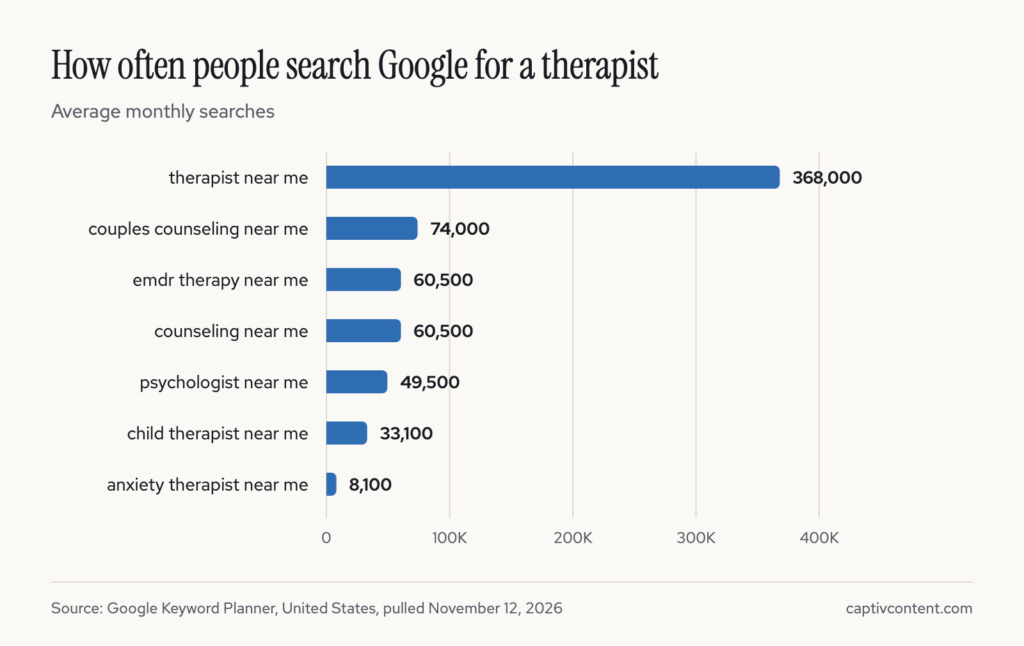
A directory is also only one of the places people look. "Therapist near me" is searched about 368,000 times a month on Google in the United States, based on Keyword Planner figures we pulled on November 12, 2026. Those searches lead to a map of local practices, which is covered in local SEO and Google Business Profile for therapy practices. And how to get more therapy clients explains how the directory fits with everything else.
How do you know if the profile is working?
Your account includes figures on how the profile is performing, such as how often it was viewed and how many people contacted you through it.
Read those numbers as a sequence.
- Few views: the photo or the first lines are not earning the click. Rewrite the opening.
- Viewed often, few contacts: people are interested and something on the page stops them. Check fees, availability and the closing invitation.
- Contacts, few bookings: look at how quickly you reply and how the first call goes.
Change one thing at a time and give it a month before judging. Also ask every new client how they found you. Some people find you on the directory and then call the number on your website, and the profile's own figures won't show those.
Questions therapists ask about their profile
How long should my personal statement be?
Use the space the directory gives you, and put the most important lines first. Only the opening shows in search results, so a strong first two sentences matter more than the total length.
Should I write in first person or third person?
First person. "I work with" reads as a person speaking. "Dr. Smith works with" reads as a biography, and it puts distance between you and the reader.
How often should I update my profile?
Review it every few months, and whenever your availability, fees, insurance list or focus changes. An accurate profile saves both you and the caller time.
Can I use client testimonials on my profile?
Check your ethics code first. The APA Ethics Code (standard 5.05) bars psychologists from soliciting testimonials from current therapy clients, and the codes for counselors and social workers have similar limits. Our upcoming post on reviews and reputation for therapists will go through what is allowed.
Is Psychology Today worth paying for?
That depends on what it brings you. Track how many clients come from it over three months and compare that with the fee. For many practices one client covers a year of membership. If it brings nobody after you have improved the profile, the money may do more elsewhere.
If you want your profile and website working together
A directory profile works best as one part of a plan, which we lay out in our guide to marketing for therapists. If you'd like help with the profile, the website it points to or both, start a conversation.
About the author: Matt Marrs is the co-founder and CEO of CaptivContent, a marketing firm that works only with behavioral health organizations.
This article is general marketing guidance. It is not legal or compliance advice. Follow your licensing board's rules and the code of ethics for your profession.