


It started the way it almost always does: a Sunday afternoon, a best friend, and a football game on the television.
Jake, a 20-year-old sophomore at a large Midwestern university, first made a sports bet at the beginning of his freshman year. He placed a $15 wager via his friend’s account on a Monday Night Football parlay. He had won only $47, and by his junior year had lost almost $8,000 (the bulk of it borrowed), and had dropped out of two classes he could not concentrate on.
“I didn’t even realize it had become a problem,” he said. “It just felt like part of watching sports.” Jake’s story is not unique, nor is it unusual.
After the Supreme Court in 2018 overturned the federal ban on sports betting, more than 38 states have legalized it in some form on a state-by-state basis. This can be seen in the massive expansion of betting apps, advertising and the party atmosphere on college campuses across the nation.
As of 2023, 58% of young adults between 18 and 22 from across the US have engaged in at least one form of sports betting, per a revolutionary NCAA study surveying 3,527 individuals. This figure increases to 67% for those living on college campuses. More students gamble on sports than participate in Greek life, student government, and most other campus organizations combined, according to a recent study.
There is also a meaningful gender gap in problem gambling, as men tend to gamble more, gamble more often and with greater amounts than women. Young, single, male students have been found to fall into one of the highest risk groups for problem gambling.
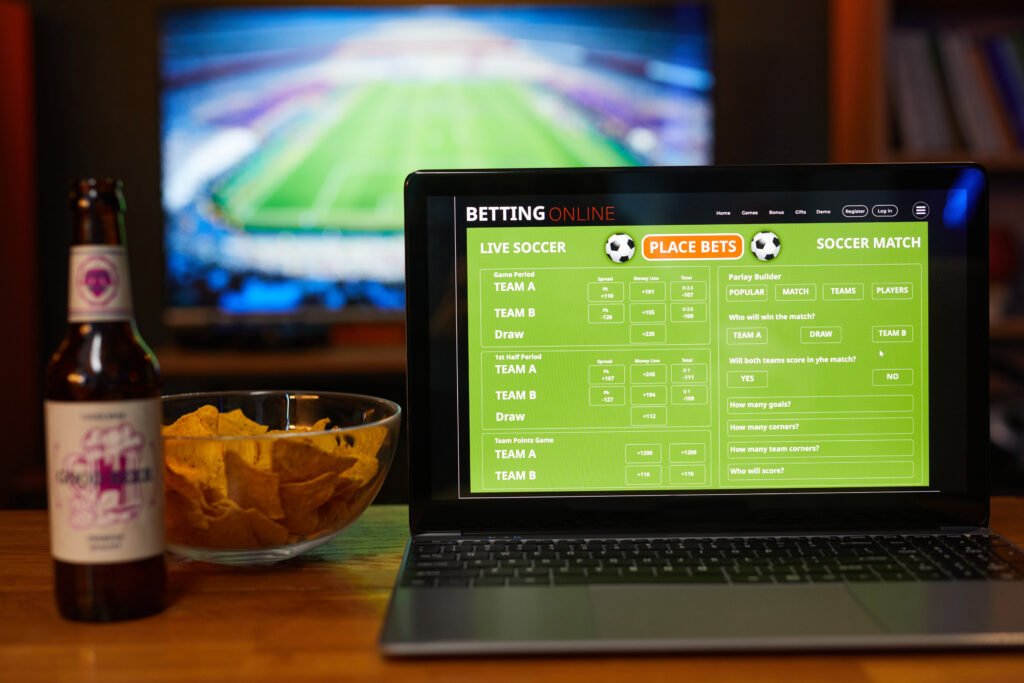
Ask any college student, and they’ll tell you that getting on DraftKings or FanDuel takes about four minutes. A credit card, a phone number, and you’re live. The apps tap into many of the same psychological tactics as social media, like:
Live in-game betting has supercharged the problem. Instead of a one-off bet before the game started, now you can bet on every drive, every at-bat, every possession. The three-hour game becomes, dozens of decisions across the 60 minutes. According to the NCAA survey, live betting on games is now the most popular form of betting among college-age consumers.
And the advertising, they concluded, is all but inescapable; according to the same NCAA survey, 63 percent of a campus’s students are routinely exposed to sports betting ads. Of those who remembered the ads, 58% said that the ads made them more likely to place a bet.
“Sports betting has been marketed heavily to the young men who are the biggest consumers of sports,” said Dan Cassino, who studies gambling behavior at Fairleigh Dickinson University. In a study published in 2024, he found that 26 percent of men under the age of 45 had placed internet sports bets in the last year, nearly three times the national average.
Most college students who gamble are not problematic gamblers; they are sports fans and like to follow teams. Everybody just wants to have “skin in the game.” But the path from casual to compulsive is shorter than most people think, and that is why the brain science matters.
Also, young adults’ prefrontal cortexes, or the part of the brain that inhibits impulses and considers the future, aren’t fully developed until age 25. Add to that the addictive nature of these apps, the easy availability of credit cards, and the pressure of seeing a room full of your peers hunched over the same betting app, and you’ve got a problem.
Statistics of problem gambling in this group are also disturbing. According to a 2024 Fairleigh Dickinson University poll, 10% of men in this age group scored positive for gambling disorder on a clinical problem gambling scale. This would be more than three times the rate among adults, with the NCAA finding in a survey of college-age gamblers that 16.0% of them had engaged in a risky gambling behavior and 6.0% reported that they had lost more than $500 on a single day of gambling.
For example, 70% of at-risk gamblers believe that they will win money frequently by betting on sporting events, which is very unlikely and shows the skewed way that at-risk gamblers think about and handle risk.
While the financial losses are the most obvious harm to the young man, the effects of gambling on his mental and social well-being are less well understood by parents or counsellors.
Academically, student gamblers report difficulties concentrating in class or sleeping because they are monitoring games that are in different time zones, and skipping classes and completing assignments to monitor their wagers. In surveys of college students, 35% said they have bet through a student bookie. That made it common enough among college sports bettors that in most campuses it all but made it impossible for students who wanted to abstain from gambling to do so.
Usually, anxiety and depression are comorbid with problem gambling. After all, there are the highs and there are the lows, and unlike with drugs, there is no script that tells you when it is too much. The majority of young men don’t see their gambling as a mental health issue, they see it as a bad run.
Debt to friends and family and gambling-induced mood swings (including euphoria and depression) further weaken bonds, eroding the trust that strengthens college friendships and family relationships in general.

If you have a college-age son, the sports betting conversation is one worth having, even if you don’t know for certain that he has placed a bet.
The National Council on Problem Gambling also has a state-wide helpline, 1-800-522-4700, and a national 24/7 helpline. Many universities have gambling counselors through their counseling centers. The NCAA also ran an awareness campaign called Draw the Line with resources for college students.
Because billions of dollars are wagered every year and legalization efforts are continuing, sports gambling is not going to go away. To most adults, it is considered recreational gambling. But that is not the case for a much larger and growing number of these men.
It is the mobile apps, the live odds, the Instagram feeds that make wagering feel benign and entertaining to some but are the same features that others can’t look away from. The gambling industry’s promise of accessibility is, for people who are affected by gambling problems, often the opposite.
Jake has since sought counseling on campus after what he calls “a very awkward intervention” from a good friend. While he hasn’t bet for over a year, Jake is still paying off his debts.
“I wish someone had told me earlier that the apps are designed to keep you in,” he said.
“They’re not rooting for you to win. They’re rooting for you to come back.”
Help is Available: If you or someone you know has a gambling problem, please call the National Council on Problem Gambling 24/7 helpline at 1-800-522-4700.