Is AI Writing Killing Your Google Rankings? Here’s What Business Owners Need to Know
If you’ve been using AI writing tools like ChatGPT to write blog posts, landing pages, and product descriptions, you’re not alone․ Millions of businesses are using ChatGPT and other AI writing tools to speed up content creation․ And honestly, it makes sense․ Who wouldn’t want to read a 1000-word article in 30 seconds?
The problem is, there is a lot of stuff killing businesses on Google search results and most business owners don’t even know it exists․
We’ll break down exactly what’s happening, how it’s impacting your SEO, and what you can do to safeguard your ranking․
The AI Content Explosion (And Why Google Noticed)
Since ChatGPT was released in late 2022, the internet has been flooded in AI-generated content․ These comprise blog posts, FAQs, service pages, buying guides, and other content․ These pages were created at scale with little human oversight and, for a period, ranked perfectly fine․
Google was paying attention at that point․
In March 2024, Google announced both a core algorithm update and a spam policy update, both set out to remove a further 40% of low-quality, unoriginal content from search results․ But when it rolled out, websites lost traffic overnight, and others were completely deindexed․ They compared the number of affected sites with the updates of Panda and Penguin, that had occurred 10 years earlier, as the last time Google performed common updates to address mass-produced junk content․
Does Google Really Penalize AI Content?
Here’s where the line gets a little blurry, and where a lot of businesses trip up․
Google does not have an “AI penalty”․ Google has said that it will continue to reward content that is high quality and helpful as long as it is content that a human would find useful․ High-quality, well-researched, and helpful content that just so happens to be written by AI will not be penalized․
What Google does not reward is low-quality content․ The problem with artificially-generated content is that it is almost always low quality when used in the wrong way․
The Risks of “Single-Click” Content
For example, if someone simply hits “generate” in an AI tool with a simple query, the output is going to be:
Not very specific
Repetitive of things already ranking
Lacking unique data, perspectives, or expertise
Google’s SpamBrain artificial intelligence spam detection system uses a number of factors to assess thin, templated, mass-produced content․ The factors include considering whether the content actually answers a searcher’s question, the uniqueness it brings to the search results, and also whether users spend a good amount of time on a page or quickly bounce back to the SERP․
Real-world Impact on Businesses
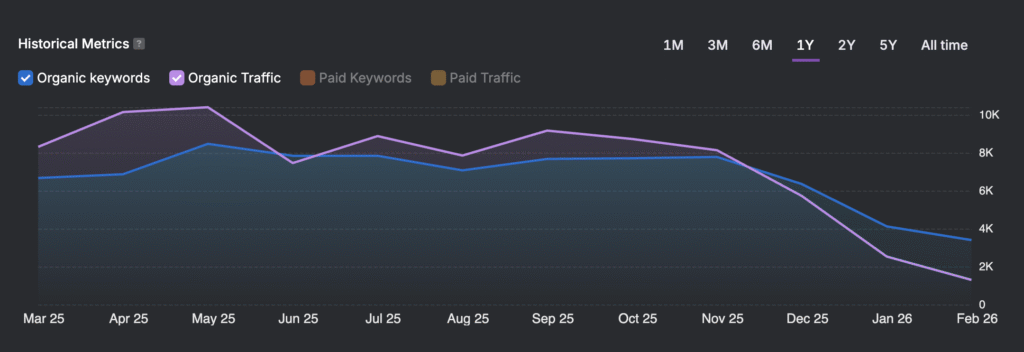
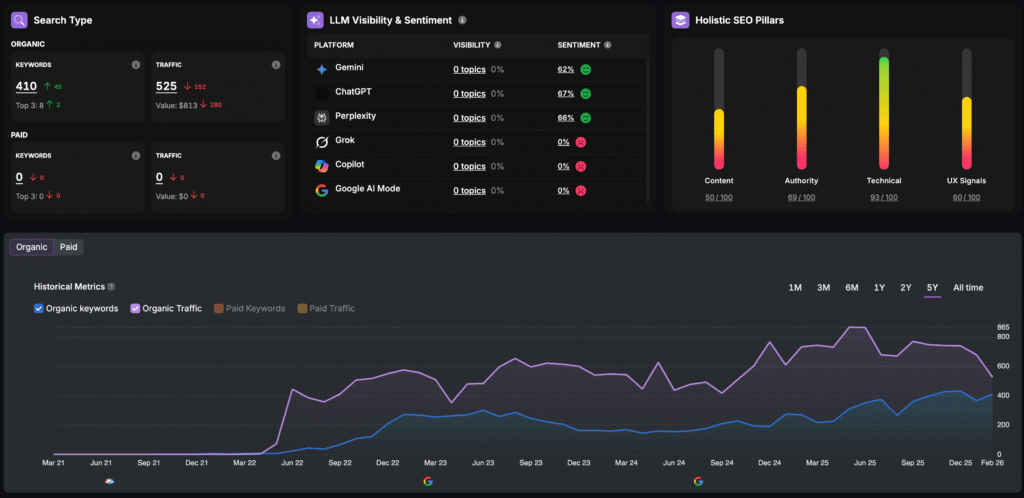
Overall, AI-generated content had negative effects on website rankings․ In studies of search results after Google’s 2024 rollout of their new search ranking algorithms, on average, websites generating entirely unedited AI content saw a 17% drop in organic search traffic and a decline of eight positions in ranking․ In one study of 500 first-page search results, human-created content dominated, comprising approximately 83% of top results in high-volume keywords․
Case Study: One blogger replaced just the meta description and first paragraph of an 8,000-word piece written by a human with text generated by an AI model, and their organic traffic immediately dropped from around 40 clicks a day to zero․ Once rewritten by a human, traffic returned․
Then in June 2025, Google confirmed that they started issuing a manual action for their so-called “scaled content abuse”: a manual penalty for web sites publishing AI-generated content at scale with little human involvement․
Why AI Content Struggles to Rank
Google judges content using its E-E-A-T or Quality Rater Guidelines: Experience, Expertise, Authoritativeness, and Trustworthiness․ AI generated content is virtually always inadequate as it cannot draw upon real life experience․ It doesn’t cite original research․ It doesn’t present a viewpoint that is truly its own․
There is also the issue of engagement; when users find low-effort AI content that does not answer their query, they will leave․ Google interprets a high bounce rate as a negative ranking signal․ Finally, there’s the sameness problem: When everyone uses the same AI tools, the output looks similar, which conflicts with Google’s desire for original content․
What This Means for Your Business
If you’ve been publishing AI content without editing, study its performance with an audit:
Check Google Search Console for drops in clicks/impressions.
Monitor bounce rates in your analytics.
Check for manual action notifications.
The bright side? It doesn’t mean AI’s off the table․ Provided you use it as a starting point, not an endpoint․
Best Practices: How to Use AI Without Hurting Your SEO
Human-Led Editing: Draft text using AI and then have it edited by someone fluent in the topic․
Add Unique Value: Layer on your own insights, opinions, statistics, customer examples, and case studies․
Quality Over Quantity: Publishing three high-quality, long-form articles per month is almost always preferable to 30 generic AI produced pieces․
Write for Humans First: Ask yourself: Does it answer the question better than what’s already ranking?
Prove E-E-A-T: Include author bylines, credentials, and reputable sources with publication dates․
Continuous Quality Checks: Use behavior analytics to identify underperforming pages before they affect site authority․
So What Do You Do With AI?
AI writing isn’t going away, and it doesn’t have to be the enemy of your SEO․ But the “generate and publish” days are over․ The winning search businesses of the next decade will be the ones that use AI as a co-pilot, not a content factory․ One of the biggest bets you can make is to use that AI to help you structure and draft your research, then add the human perception and voice that an algorithm cannot duplicate․