


Publishing posts randomly in the hopes they will be shared is not a social media marketing strategy.
When you fail to strategize, you end up simply creating without a purpose. Your competitors then pull ahead and you find yourself left behind.
When you have the right strategy, you can reach the right people, create the right content, and measure what really drives results so you can adjust what doesn’t work.
This guide provides practical tips on how to build a social media marketing strategy that drives business results.
A strong social media marketing plan starts with social media goals. You can’t measure success or allocate your resources properly without knowing what you’re trying to achieve. Your platform, content and measurement all depend on those clear outcomes.
The SMART acronym stands for Specific, Measurable, Attainable (or Achievable), Relevant, and Time-bound. It is used for clarifying vague goals into a more specific goal. It changes the goal from “grow our audience” to “Increase Instagram followers by 20% over the next six months to support our brand awareness campaign.”
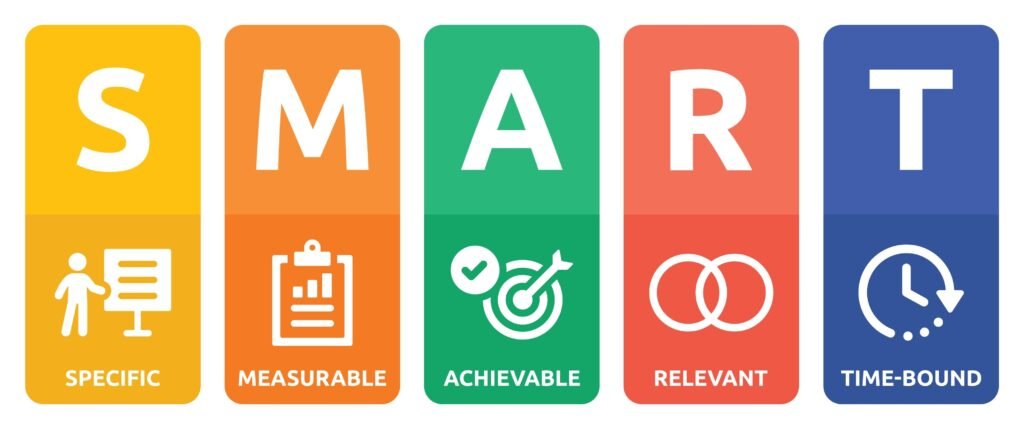
Specific goals clearly define what you want to achieve. Measurable goals provide a quantifiable or KPI-based way to measure progress. Your goals should be realistic, so you can achieve them within your budget and deadlines. They should also align with your business or marketing objectives. Time-bound goals have deadlines, which encourage focus and accountability.
You need a narrow set of 1 to 3 goals, set at the level of the business’s maturity. More metrics dilute your strategy. You can expand as you scale, but starting concentrated makes it so your team is aligned and your efforts measured.
As with any tool, social media should be prioritized according to business goals. One survey found that 65 percent of managers want to know how social media campaigns link back to business priorities. This gives the budget manager a basis to justify the spending and prove return.
Align your goals to the customer journey stage. At the top of the funnel in the discovery phase, the goals typically include impressions, reach, and new followers. There are also middle-of-funnel consideration goals, such as clicks, engagement or website visits, bottom-of-funnel conversion goals including leads, purchases, downloads, and sign-ups, and retention and loyalty goals such as satisfaction, advocacy, and referrals.
Within this framework, when your business goal is to break into a new vertical, your social goal may be to increase your LinkedIn following in that vertical by 25% over the next six months. If lead generation is the business goal, the social goal might be to get 300 visits a month to gated content via social posts.
Your KPIs must be tied to your goals. Your metrics are not all equal. KPIs are different from other metrics because they are directly tied to business goals and the bottom line.
Awareness: Reach or impressions (the number of people who have seen your content), the follower growth rate for your organization, or your mentions/share of voice relative to other organizations.
Engagement: Includes likes, comments, shares, replies, reshares, saves (on Instagram Reels or TikTok), and clicks on links. This can be calculated by dividing total engagement by reach or follower count.
Conversions: Illustrate how well social media is driving traffic to a website, capturing leads, or closing sales. Examples include click-through rate, website traffic from social (using UTM tracking), leads generated, purchases/revenue, and cost per lead or click.
Customer Service: Metrics include response rate (percentage of messages answered), average response time, resolution rate (percentage of cases solved), and customer satisfaction score.
Vanity metrics, such as followers and likes, offer no or little value to the business. A brand may have 20,000 followers, but if they never like, comment, or buy anything, they can be more or less worthless.
These metrics are often not the right metrics. They’re not leading indicators of the business and product, and aren’t actionable. Adding 12,000 subscribers to your list is meaningless if only 200 of those new subscribers are actually opening and clicking each month.
Focus on metrics that show the performance of your business, such as conversion rates, cost per acquisition, and customer lifetime value. These help inform business strategy.
Even if you know what you want to do, that knowledge means nothing if you don’t know who you’re making it for. That’s why audience research is vital: it helps you reverse engineer and understand who to target and where to do it.
With 5.66 billion social media users in the world, it has now reached supermajority level with 93.8% of all internet users using social media. On average, a user has 6.75 social media accounts per month.
Age remains a strong demographic predictor of social media use:
Ages 16-24: Spend the most time daily (3.5 hours across 4.6 days per week).
Ages 25-34: Average approximately 4.4 days a week and under 3 hours a day.
Platform popularity also shifts by generation:
Gen Z: YouTube (91%), Instagram (86%), TikTok (79%), Facebook (77%).
Millennials: YouTube (90%), Facebook (89%), Instagram (81%), TikTok (69%).
Gen X: Facebook (88%), YouTube (83%), Instagram (60%), TikTok (46%).
Baby Boomers: Facebook (88%), YouTube (69%), Instagram (39%), TikTok (20%).
This shift is also reflected in search behavior; 41% of Gen Z reported they would rather perform a social search than use traditional search engines.
A buyer persona is a semi-fictional representation of the target audience based on demographics, behaviors, motivations, and pain points.
Quantitative Data: Use analytics tools to gather data on age, gender, location, income, and job title.
Behavioral Data: Monitor how customers interact with content (e.g., video vs. text).
Qualitative Data: Collect insights through customer interviews or social listening. Identify the problems your audience is trying to solve.
Create 2-5 personas, each with a name, stock photo, and detailed profile. Make them realistic enough that your team can reference them when strategizing.
Ultimately, where the content ends up is entirely dictated by who it is trying to reach. Find the places your personas already inhabit:
LinkedIn: Ideal for B2B brands; drives 80% of all B2B social leads.
Instagram & TikTok: Best for visual brands and younger demographics.
Facebook: Widest overall reach, particularly strong for the 30-49 age range.
Once you select your platforms, optimize your profiles:
Ensure handles match your brand name.
Fill in all information (bio, location, email, website URL).
Include keywords in your bio for searchability.
Add verification badges and use current branding for profile/cover images.
The most important aspect of a successful social media marketing strategy is the foundation. Creating SMART goals and knowing your audience demographics takes you from a trial-and-error approach to a data-driven strategy. You now know exactly who you are talking to and where those conversations are happening.
Knowing your audience is half the battle; the other half is knowing what’s out there, understanding your competition, and creating scroll-stopping content.
In the next post, you’ll learn about the execution stage of the process, including how to analyze your competition, create a content calendar, and measure your results.